The Meta3™ Framework and the Case for Cognitive Infrastructure in Organizations
In a recent LinkedIn series, we've followed Sydney, a character from the film Office Romance, through four moments that the most successful organizational leadership frameworks name and build. Each moment mapped to a brain region. Each brain region mapped to a leadership capacity. Each capacity mapped to the gap that keeps talented executives from executing on what they already know.
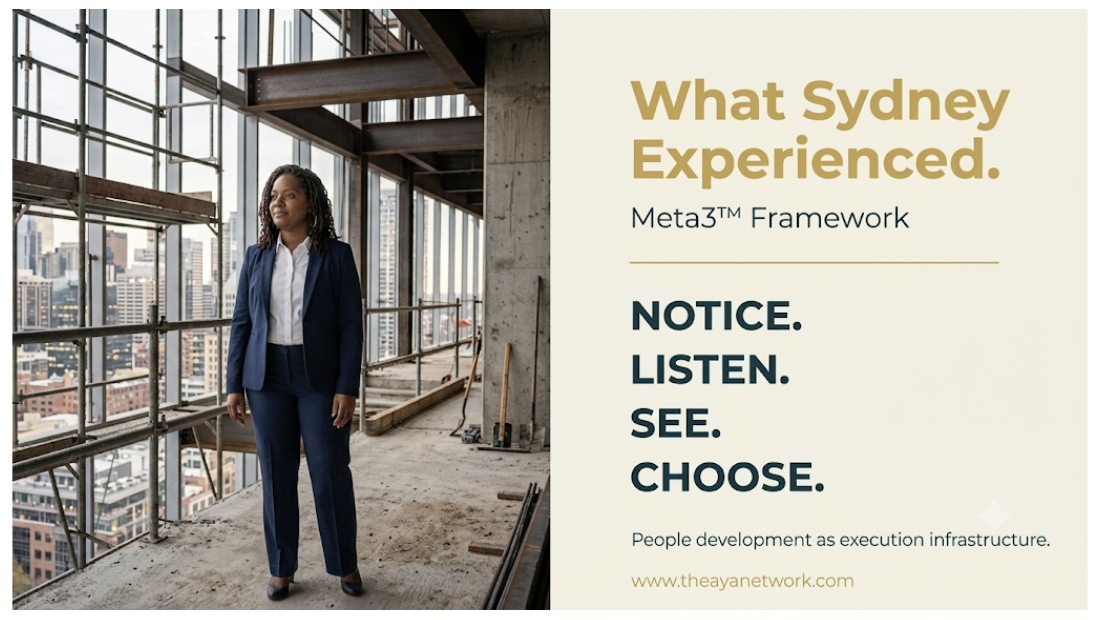
Before the observation. Before the pattern. Before the decision.
There's a moment almost every leader faces when something feels different, but we haven't named the difference yet. Sydney lived in that moment longer than most, collecting triangulated data over time. What she did with it changed the outcome for an organization, for her CEO, and for herself.
Here's the full arc.
Notice. (Thalamus + Anterior Cingulate Cortex)
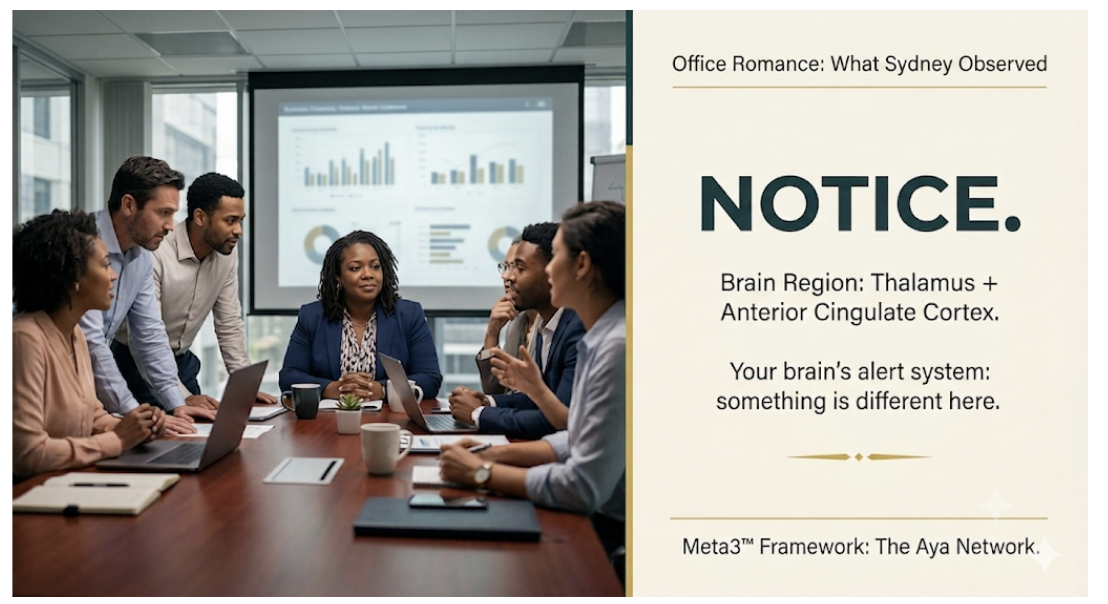
NOTICE: What the body catches before the mind names it.
Sydney didn't know what she was looking at yet. She just knew something was different. That's Notice: the first signal, the one that transformative leaders embrace and examine.
Sydney's first moment wasn't dramatic. It was subtle. Something felt different in the room: a shift in energy, a misalignment between what was being said and what was actually happening. She caught it. Effective leaders do.
Notice is the capacity to register that something is different before we can name what it is. The thalamus routes incoming information; the anterior cingulate cortex flags when something doesn't match expectation. Together, they create the biological conditions for attention but only if the leader has trained themselves to slow down long enough to feel the signal.
What made Sydney's noticing possible wasn't just awareness. It was loyalty. She was paying attention because she was invested in Jackie, in the relationship, in the truth of what was happening between them. Loyalty didn't just motivate her to stay. It sharpened what she could see.
Organizations don't build for Notice. They build for speed. But the pause is where the data enters.
Listen. (Default Mode Network)
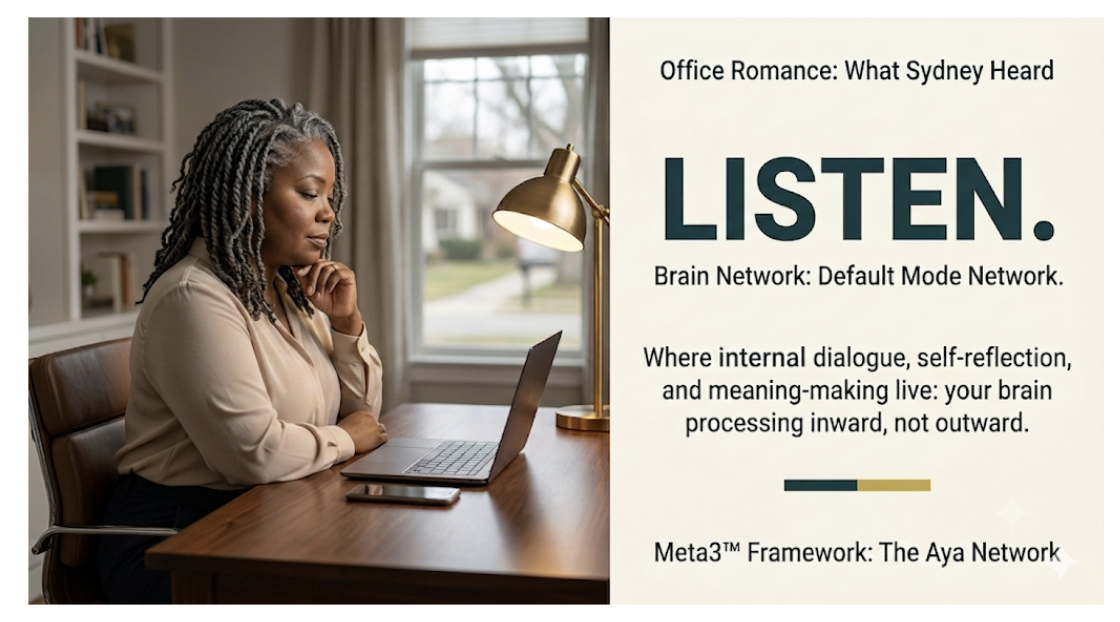
LISTEN:
What meaning sounds like before it becomes a conclusion.
After Sydney noticed, she didn't move. She sat with it. Listen is the practice of holding a question open long enough for meaning to form, without forcing an answer the situation isn't ready to give.
After Sydney noticed, she didn't react. She sat with it. She let the meaning surface rather than forcing a conclusion.
That's the Default Mode Network at work: the brain's internal processing system, active when we're not focused on external tasks. It's where we make meaning. Where we connect the present moment to memory, pattern, and context. Where a feeling becomes a thought.
Listen is the practice of creating enough internal space for meaning to form without prematurely collapsing it into certainty. It requires tolerating ambiguity, one of the most underdeveloped capacities in fast-moving organizational cultures.
Sydney's accountability kept her honest here. She didn't assign blame or reach for the most convenient interpretation. She held the question open. She stayed responsible for what she was observing rather than outsourcing the meaning to someone else. Accountability, in this phase, looked like intellectual discipline.
The Listen stage is where most strategic errors are bor, not because leaders are incapable of making meaning, but because the system demanded an answer before the meaning was ready.
See. (Basal Ganglia + Ventromedial Prefrontal Cortex)
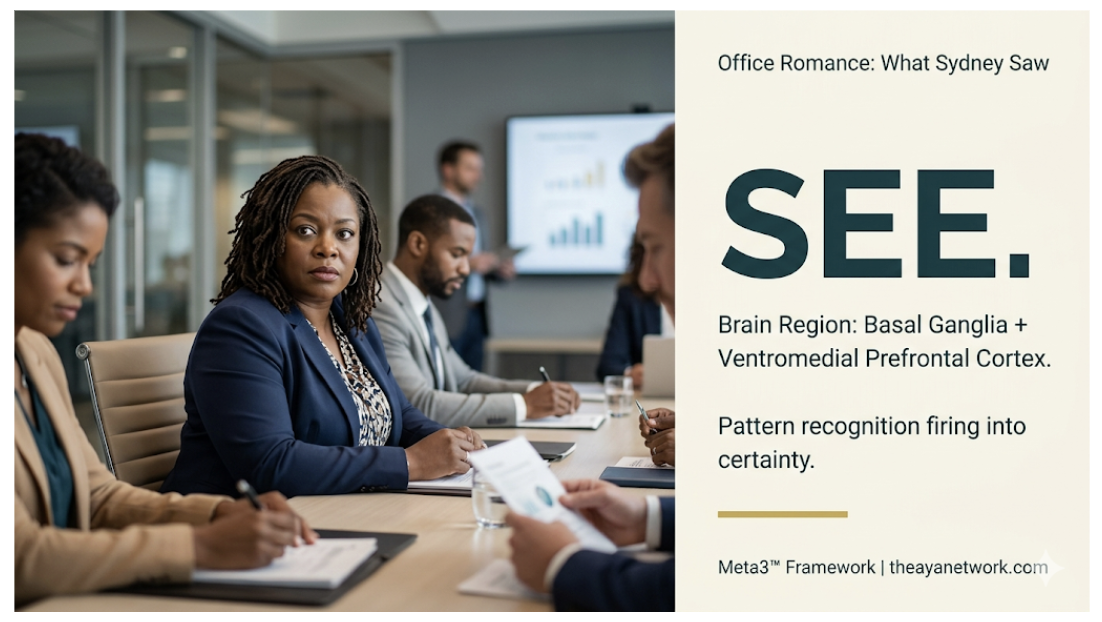
SEE: When isolated moments become a pattern you can act on.
At some point the data connected. What Sydney had been noticing and listening to stopped being fragments and became a picture. That's See: pattern recognition firing into certainty.
At some point, Sydney's individual observations stopped being isolated data points and became a picture.
That's See. Pattern recognition firing into certainty.
The basal ganglia and ventromedial prefrontal cortex work together to match current observation against accumulated knowledge — across time, across interactions, across context. When those pieces connect, a suspicion becomes knowledge. A read becomes reliable.
What Sydney saw wasn't just a pattern. It was a pattern that demanded a response — and she knew it. That's where justice entered. Not as anger. Not as judgment. As clarity about what was right, what was owed, and what could no longer be ignored.
Justice, at the See stage, is what converts pattern into moral weight. It's what makes a leader act on what they know rather than file it away.
See is one of the most underdeveloped practices in organizational leadership, not because leaders lack the capacity, but because the system rarely builds for it. Leaders are rewarded for fast decisions, not accumulated observation. The ones who can get to See — really See — are the ones whose interventions land. Whose reads hold up. Whose choices carry weight.
Choose. (Prefrontal Cortex)
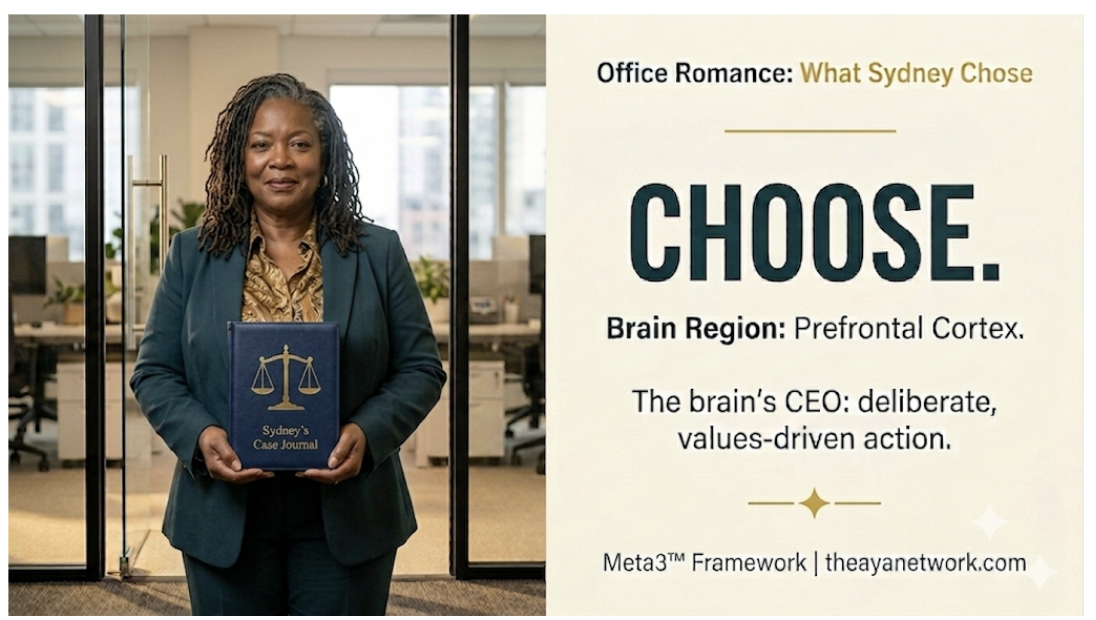
CHOOSE: Where observation becomes direction.
Sydney didn't react. She responded. The prefrontal cortex, the brain's CEO, took everything the system had gathered and moved with intention. Loyalty. Accountability. Justice. Courage. Truth-telling as an act of love. That's what Choose looks like.
After all of that, Sydney chose.
Not reacted. Chose.
The prefrontal cortex is the brain's CEO: the seat of deliberate, values-driven action. It takes everything the system has gathered and moves with intention, with alignment, with the confidence that comes from having done the work.
Sydney's five values were all present in this moment:
Loyalty: she stayed present to the relationship even when disengaging would have been easier.
Accountability: she didn't outsource the observation or the decision to someone else.
Justice: her Choose wasn't self-protective. It was principled.
Courage: she acted on what she saw without a guaranteed outcome.
Truth-telling as an act of love: for Jackie, yes. But also for herself and for the integrity of the work.
This is what the prefrontal cortex executes when it has something to work with. Not just data. Values. The Choose wasn't fast. It was earned. And because it was earned, it landed.
Reaction lives in the body. Response lives in the mind that has done the work. The distinction is not semantic. It's strategic.
The Organizational Argument.
Here's where the series closes — and the argument opens.

THE ORGANIZATIONAL ARGUMENT: What Sydney's story means for your leadership.
Notice. Listen. See. Choose. This isn't just Sydney's arc. It's the sequence living inside successful executive teams. Meta3™ builds this capacity on purpose because values are execution infrastructure, and the gap between intention and action has a root cause worth naming. Meta3™ names this gap with a precise entry point and aligned action—>www.theayanetwork.com.
Notice. Listen. See. Choose. This is not a personal development sequence. It is an execution system. And the organizations that embed it into how they lead — not just what they say they value — are the ones whose strategy actually reaches the ground.
The gap between vision and execution is the defining leadership problem of our time. Boards feel it. CEOs name it. Executive teams work around it. But the gap persists because it's being addressed at the wrong level — through better planning, clearer communication, stronger accountability structures — when the root cause is cognitive.
Leaders are making decisions at the speed of reaction, without the accumulated observation that makes a decision land. Values are invoked in culture decks but rarely activated in the moment of Choose. Pattern recognition is assumed but never built. Internal signals are overridden by urgency.
Sydney had Loyalty, Accountability, Justice, Courage, and truth-telling as an act of love. Those weren't aspirational. They were operational. They shaped what she noticed, how she listened, what she saw, and ultimately what she chose.
That's the organizational argument for Meta3™.
Values are execution infrastructure. Not a sentiment. Not a branding exercise. The actual operating system through which a leader converts vision into action, intention into impact, strategy into something that moves people rather than manages them.
Meta3™ builds this capacity on purpose — at the individual, interpersonal level, team level, and organizational levels simultaneously. Because the gap doesn't live in one place. And neither does the solution.
Sydney's story ends with a choice. Ours begins with awareness, acceptance, responsibility, and practice.
Notice. Listen. See. Choose.
That's the framework. That's the argument. That's the work.
Meta3™ is a proprietary organizational diagnostic framework developed by Dr. Kelli Seaton, Founder and CEO of The Aya Network. Learn more at theayanetwork.com.
