The C-Suite Stakeholder Framework: How to Prioritize Relationships That Matter When Trust is at 4/10
Part of the Meta3™ Framework Series
By Dr. Kelli Seaton
The Situation: The Pattern That Emerged
Manager trust is at 4/10.
Team turnover is at 60%.
Communication is breaking down.
And Mark, the Chief Operating Officer, know something needs to be said.
But here's the question that keeps him silent: "What if speaking up makes it worse?"
Imagine that the Q3 team experience assessment showed clear problems:
Manager trust: 4/10
Team communication: breaking down
Retention crisis: 41%+ turnover
Team members feeling turbulence but unable to name it
Leadership asking "how's the team doing?" but not getting honest answers
The reality was undeniable:
Team members were feeling turbulence in their roles
Team members discussed team dynamics but couldn't put a name on it
Leadership had been asking how the team is doing
These feelings could be helpful insight.
But what if Mark keeps defaulting to silence. "Someone else will speak up." "I don't want to be the one to say anything." "It's not my place."
Until Mark realized: His practiced value (Avoid Conflict) was undermining his aspirational value (Evidence Over Ego, Transparent Reasoning).
So Mark used a framework to turn ego into strategy.
The Meta3™ Framework: From Ego Block to Strategic Action
Level 1: NOTICE THE THOUGHT
"I've been feeling this thing for awhile, but I don't know what to say. It's like we are struggling to talk to one another…but we need to communicate in order to launch the next partnership. I don't want to be the one to say anything."
Physical sensation: stomach drop, tension, the familiar feeling of wanting to disappear.
This is the Avoid Conflict ego block in action.
Level 2: LISTEN - THE INTERNAL DIALOGUE
Two distinct voices showed up:
Self 1 (Protector): "Don't say anything. Someone else will speak up. You've only been on the team for 2 years—you don't have enough standing. What if they think you're being dramatic? What if this makes your relationship with the CEO worse?"
Self 2 (Learner): "You've been on the team for over 2 years. You have solid ideas. Share them. If you don't speak up, you're complicit. The data is clear. This isn't about you—it's about the team."
Level 3: CHOOSE - THE PHOTOGRAPHER STEPS IN
The Photographer Sees: "Self 1 protects you from short-term discomfort. But then the problems persist. And when you don't speak up, you're complicit."
Which voice aligns with who I'm becoming?
Evidence over ego: Question what's happening
Transparent reasoning: Show what's happening
= CONTRIBUTE TO TRANSPARENCY
Mark chose Self 2. He scheduled a 1:1 with the CEO. But he didn’t just share his feelings, he shared a framework.
The Stakeholder Salience Model: Turning Insight Into Strategy
With manager trust at 4/10, communication breaking down, and 41% turnover, this was an opportunity for stakeholder conversations.
The Stakeholder Salience Model helps teams and organizations identify high-influence communication strategies that help solve problems more efficiently.
The model asks three questions about any stakeholder:
1. POWER: Do they control resources and decisions?
2. LEGITIMACY: Are they directly affected by the team's work?
3. URGENCY: Do they have time-sensitive needs?
When the answer to all three is YES, you have a DEFINITIVE STAKEHOLDER.
And definitive stakeholders require:
Proactive, frequent communication
Involvement in decisions before they're finalized
Transparency about challenges
Deep relationship investment
Establishment of communication preferences
Alignment on success metrics
Regular strategic touchpoints
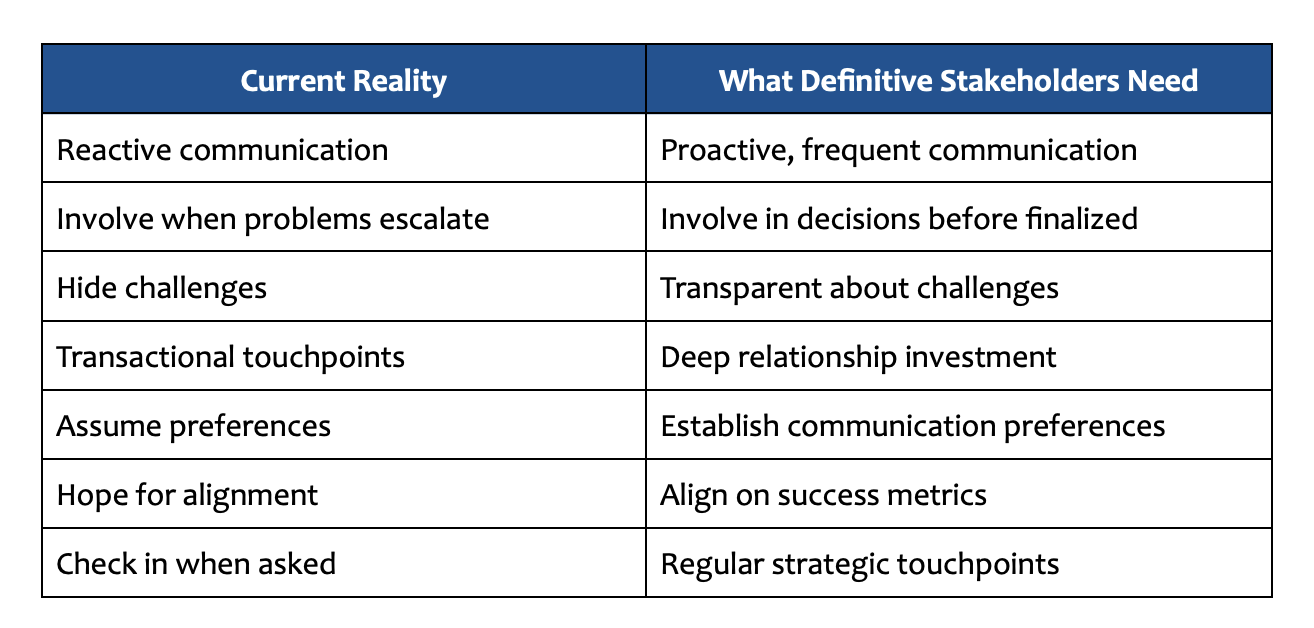
No wonder trust was at 4/10. The C-Suite wasn’t treating one of the most important stakeholder relationships (direct reports) with the care they required.
The Gap: What the Model Revealed
Here's what Mark realized: I was treating my direct reports like dormant stakeholders (only communicating when asked) when they were actually a definitive stakeholder (needed proactive updates, transparent reasoning, regular touchpoints).
The Essential Question:
Mark made the choice.
He scheduled the 1:1.
He shared the Stakeholder Salience Model.
And Mark asked: "What if we showed our manager, direct reports, and colleagues the same consideration and deference we show our clients? How might that impact collaboration and decision-making?"
Specifically: "What if we treated the definitive stakeholders—with the same proactive communication we give clients?"
The result?
Communication patterns shifted - We established weekly strategic touchpoints instead of reactive check-ins
Transparency became the norm - We started sharing challenges proactively, not just when they became crises
The stalled partnership got back on track - Clear communication preferences meant no more guessing
Trust started rebuilding - Manager trust moved from 4/10 toward measurable improvement
But more importantly: Mark didn't just solve one communication problem. He built a framework for strategic relationship management.
Why This Framework Works: Strategy WITH Courage
Here's what most people miss about difficult conversations:
They think it's ONLY about courage.
"I just need to be brave." "I need to find the right words." "I need to overcome my fear."
But courage without strategy is just risk-taking.
The Stakeholder Salience Model reframes the conversation:
Instead of: "Should I say something?" (personal risk assessment)
It becomes: "What does this stakeholder relationship require?" (strategic assessment)
Instead of: "What if they get upset?" (ego protection)
It becomes: "What communication patterns serve this relationship?" (organizational responsibility)
Speaking up isn't JUST about courage. It's about strategy.
When you have a framework that shows WHY communication matters, it's no longer a personal risk—it's an organizational responsibility.
Who Qualifies as a Definitive Stakeholder?
Let's make this concrete. In most organizational contexts, your definitive stakeholders are:
Your Direct Report
Power: They control the execution of your strategy
Legitimacy: Directly affected by every decision you make
Urgency: Their success depends on timely guidance and support
What they need: Proactive communication, transparent reasoning about decisions, regular feedback (not just annual reviews), clarity on priorities, psychological safety to raise concerns
Your Manager
Power: They control your resources, opportunities, and performance outcomes
Legitimacy: Directly affected by your team's performance
Urgency: Time-sensitive need for visibility into progress, challenges, and risks
What they need: No surprises, proactive updates on both wins and challenges, clear requests when you need support, alignment on priorities, strategic thinking (not just task updates)
Your Colleagues (in cross-functional work)
Power: They control complementary resources needed for shared goals
Legitimacy: Directly affected by your team's delivery and collaboration quality
Urgency: Time-sensitive dependencies on your team's work
What they need: Proactive communication about dependencies, transparency about constraints, collaborative problem-solving, reliability in commitments
The Question You Should Be Asking: "What if we showed our manager, direct reports, and colleagues the same consideration and deference we show our clients?"
Most leaders treat external stakeholders with strategic care:
Weekly check-ins
Proactive updates
Transparent about challenges
Ask about preferences
Build trust intentionally
But internal stakeholders?
Check in when asked
Share updates when convenient
Hide challenges until they're crises
Assume preferences
Hope trust happens naturally
The gap is staggering. And it's costing organizations trust, retention, and execution velocity.
The Avoid Conflict Ego Block: Why Leaders Stay Silent
Let's name what's really happening when you know something needs to be said but you stay silent:
The Avoid Conflict ego block sounds like:
"Someone else will speak up"
"It's not my place"
"What if it makes things worse?"
"I don't want to be the problem"
What it costs you:
Problems persist and grow
You become complicit in dysfunction
Team members lose trust (they know you're not speaking up)
Strategic opportunities get missed
Relationships deteriorate slowly instead of improving incrementally
The pattern: You tell yourself you're "being kind" or "keeping the peace." But you're actually enabling dysfunction. The team sees it. They know you're not speaking up. And their trust in your leadership erodes.
Your Practice: Identify Your Definitive Stakeholders
This week, I want you to do three things:
Step 1: Map Your Stakeholder Relationships
For each of your key relationships (manager, direct reports, colleagues), ask:
Do they have POWER? (control resources/decisions)
Do they have LEGITIMACY? (directly affected by your work)
Do they have URGENCY? (time-sensitive needs)
If all three = YES, they're a definitive stakeholder.
Step 2: Assess the Gap
For each definitive stakeholder, compare:
Current reality: How are you actually communicating with them?
What they need: What do definitive stakeholders require?
Where's the gap?
Step 3: Ask the Strategic Question
Schedule a conversation with your definitive stakeholders and ask: "What communication patterns would serve our relationship better? What do you need from me that you're not currently getting?"
This isn't only about courage. It's also about strategy.
When you have a framework that shows WHY communication matters, it's no longer a personal risk—it's an organizational responsibility.
What's Coming Next Week: Next week, I'll introduce the 2x2 Reciprocal Feedback Framework—the system that makes feedback flow in both directions and builds the trust that makes execution possible.
Here's the connection:
Week 2: You identified your aspirational values
Week 3: You practiced interrupting your dominant ego block
Week 4 (this week): You learned to prioritize stakeholder relationships strategically (not emotionally)
Week 5: You'll build a reciprocal feedback system that creates accountability and psychological safety
The 2x2 Framework is how you operationalize everything you've learned so far. It's the system that transforms individual Meta3™ practice into team-wide transformation.
But it only works if you've done the work of:
Naming your ego blocks
Learning to interrupt them
Understanding which relationships require strategic investment
Without that foundation, the 2x2 becomes just another feedback form that nobody takes seriously.
With it, the 2x2 becomes the infrastructure for transcendental evolution at the team level.
The Bottom Line
Speaking up when trust is at 4/10 isn't only about finding courage.
It's also about having and consistently using (with integrity) a framework that shows you WHY the conversation matters and WHAT the relationship requires.
The Stakeholder Salience Model does exactly that.
It transforms: "Should I say something?" (ego protection)
Into: "What does this relationship require?" (strategic responsibility)
And that shift—from personal risk to organizational strategy—is what makes difficult conversations possible.
Your turn: When's the last time you asked your direct report for feedback? How do you think it went? How do they think it went? What’s the difference between the two perspectives?
Follow Dr. Kelli Seaton for the Meta3™ Framework series.
#Leadership #Meta3Framework #StrategicCommunication #ExecutiveLeadership #StakeholderManagement #TranscendentalEvolution
