The 5 Ego Blocks Sabotaging Strategic Leadership
"Why didn't I see this? I'm an executive leader. I shouldn't need this much input on an agenda for our board meeting."

Remember last week's framework?
Aspirational values are who you want to become. Practiced values are who you actually are in the moment of choice.
That was the thought that showed up when a leader, Theresa, at a national nonprofit received feedback on her proposed agenda. She could have defended her agenda. "I spent hours on this. Admitting it needs revision means incompetence."
But Theresa chose differently.
She tested the feedback. "What if there's something here I'm missing? Learning isn't incompetence. It's leadership."
The result? The board stayed focused, built momentum, and actually solved the problem using clear criteria and an evaluation plan.
But more importantly: Theresa didn't just fix one meeting. She built a learning infrastructure for problem-solving across contexts.
This is Meta3™ in action: Notice → Listen → Choose.
What Could Have Gone Wrong: The 5 Ego Blocks
Let's replay that moment through each of the five ego blocks. Any one of these could have derailed her leadership—and sabotaged the board meeting entirely.
1. Defend Image: "If I admit I don't know, they'll think I'm incompetent."

Our defensiveness is a shield we use when we think it protects us. But it really just exposes us.
When it shows up: When receiving feedback, making mistakes, or being challenged on your ideas.
What it sounds like internally:
"I'm the board chair. I've run dozens of board meetings. If I admit this agenda needs work, they'll question whether I'm the right person for this role."
What she might have said:
"I appreciate the feedback, but I've been leading board meetings for years. I think my approach will work fine."
What the photographer would capture:
Arms crossed. Tight smile. The board meeting runs 45 minutes over. Three board members check out mentally. The problem doesn't get solved. Trust erodes.
The cost:
Career plateau. When leaders can't admit knowledge gaps, they stop growing—and their teams stop trusting them.
2. Avoid Conflict: "It's not worth the confrontation."
When it shows up: When someone's behavior is problematic, decisions are wrong, or difficult conversations are needed.
What it sounds like internally:
"If I push back or ask clarifying questions about this feedback, it might create tension. I'll just smile, nod, and do it my way."
What she might have said:
"Thanks for the input! I'll definitely consider it." (Then proceeds with original plan.)
What the photographer would capture:
Polite nod. No follow-up questions. The board meeting happens with the original agenda. The problem gets discussed but not resolved. Everyone leaves frustrated, but no one names it.
The cost:
Problems grow into crises. Avoiding today's uncomfortable conversation creates next quarter's emergency.
3. Control: "If I let someone else shape this agenda, they'll do it wrong."
When it shows up: When considering delegation, alternate approaches, or letting go of tasks you've always owned.
What it sounds like internally:
"I need to own this. If I involve others or take their suggestions, they might steer it in the wrong direction. I know what the board needs."
What she might have said:
"I've got this covered. I know our board, and I know what will work."
What the photographer would capture:
Solo all-nighters. Exhaustion. The agenda is detailed but one-dimensional. The meeting feels like a presentation, not a collaboration. The leader does 90% of the talking.
The cost:
You become the bottleneck. Your team's capacity shrinks to match yours. Growth becomes impossible.
4. Ruminate on Offense: "I can't believe they said that!"

Ruminating is such a distraction and can have us so stuck that we self-sabotage.
When it shows up: After criticism, feedback that feels personal, or when someone challenges you publicly.
What it sounds like internally:
"How dare they critique my agenda? Do they know how many hours I put into this? This is so disrespectful."
What she might have said (to a colleague):
"Can you believe they had the nerve to criticize my work? After everything I've done for this organization?"
What the photographer would capture:
Venting to a colleague. Replaying the feedback conversation in her head during dinner. Distracted during the actual board meeting because she's still upset. The problem-solving suffers.
The cost:
Mental energy drain. Hours spent replaying perceived slights instead of solving the actual problem.
5. Scapegoat: "They failed because THEY didn't deliver."
When it shows up: When projects fail, results disappoint, or team performance misses targets.
What it sounds like internally:
"If this agenda doesn't work, it's because the board wasn't prepared. Or because the feedback I got was bad. This isn't on me."
What she might have said (after a failed meeting):
"Well, the board just wasn't ready to have a productive conversation. There's only so much I can do."
What the photographer would capture:
A failed board meeting. Finger-pointing. The leader explains why it wasn't her fault. The same dysfunctional pattern repeats at the next meeting.
The cost:
You rarely learn from failures. When nothing is ever your responsibility, you never grow.
Why Ego Blocks Persist: The Practiced vs. Aspirational Gap

Be the photographer of your experience.
This isn't about perfection. You won't choose Self 2 every time. That's not the goal. The goal is awareness. Because you can't interrupt a pattern you won't acknowledge.
Here's what some leaders know: Ego blocks aren't random. They're your practiced values.
Remember last week's framework? Aspirational values are who you want to become. Practiced values are who you actually are in the moment of choice.
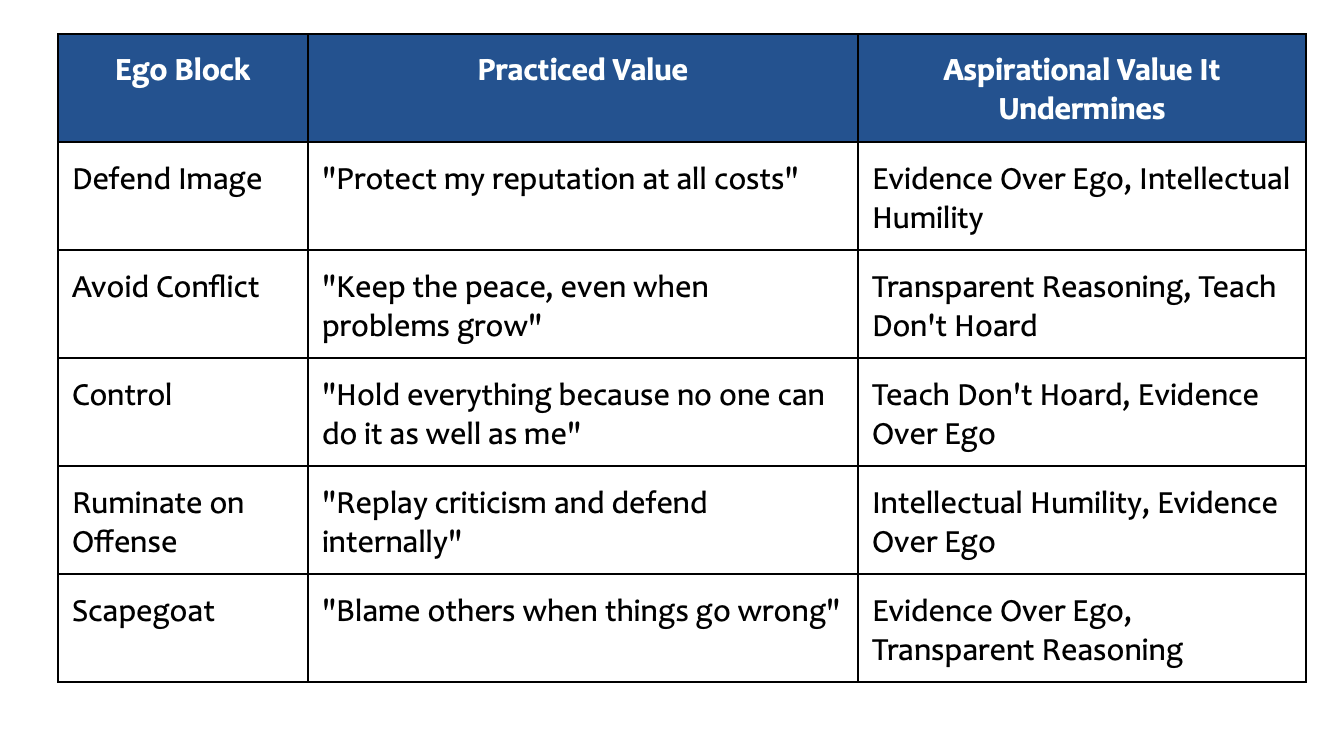
Ego blocks are practiced values on autopilot:
Make it stand out
What we practice can undermine or reinforce our aspirational values.
Meta3™ Level 3 gives you decision-making criteria grounded in your aspirational values.
Based on the board meeting agenda, it might look like this:
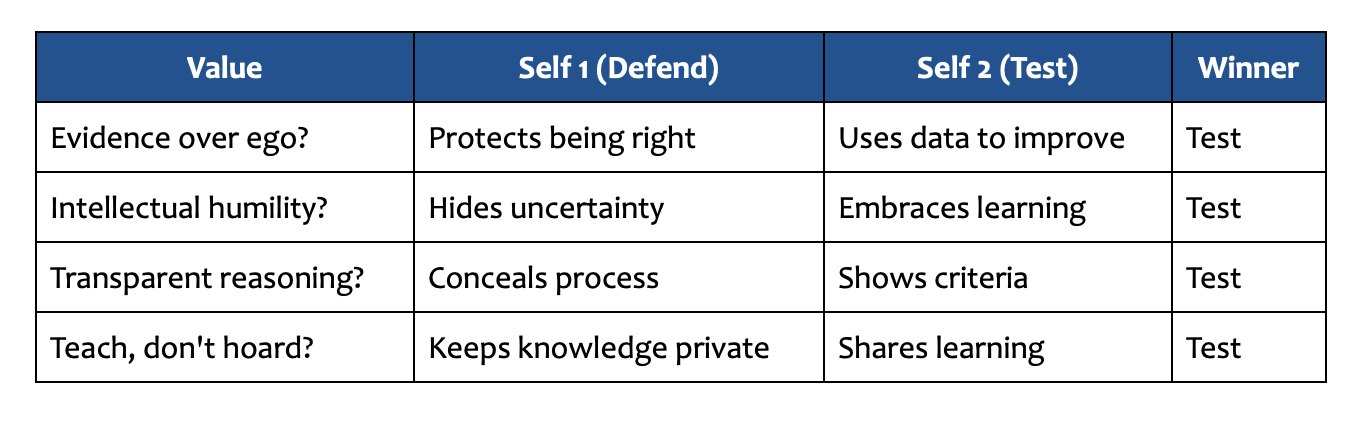
The result was clear: Choose Self 2. Test the feedback. Build the learning infrastructure.
What Actually Happened: Meta3™ in Action
Here's what Theresa actually did—and the dialogue that made the difference.
The Photographer's Final Shot
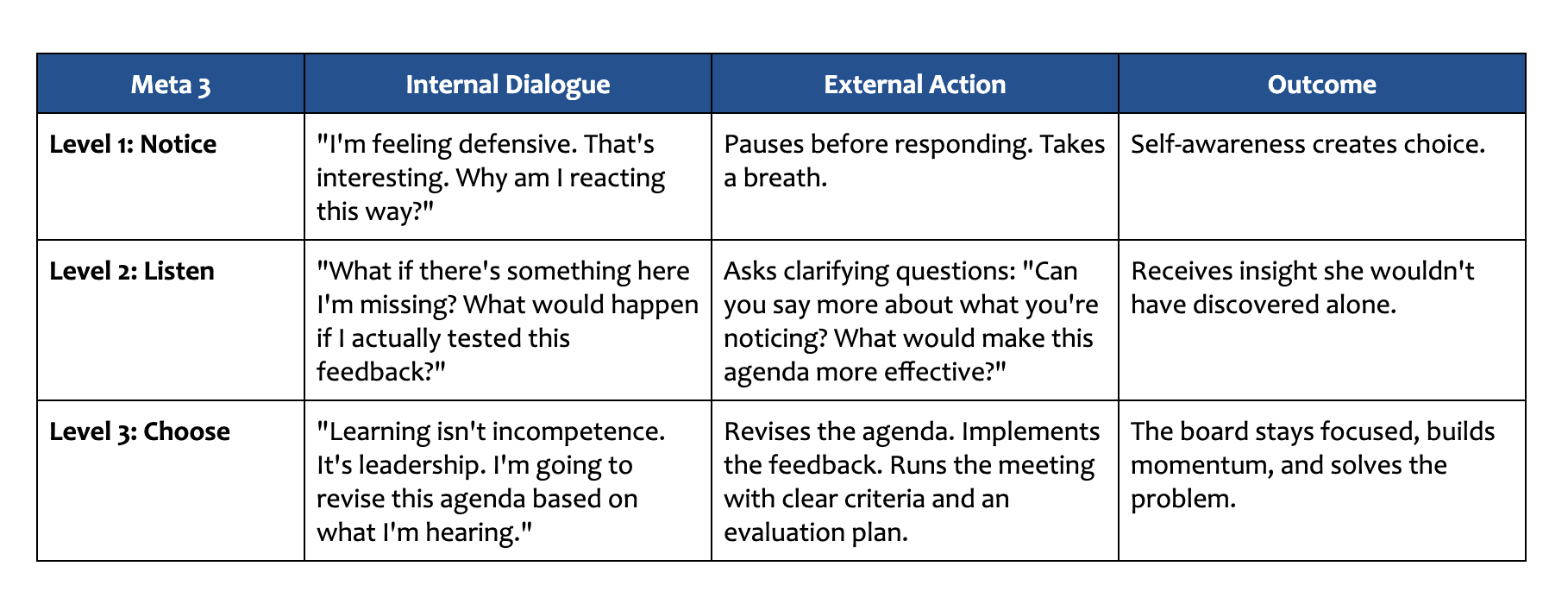
The internal dialogue versus the external action…
What the photographer actually captured:
A leader leaning in, asking questions, taking notes. A board meeting where every voice mattered. A problem that got solved. A team that grew stronger.
The difference?
Theresa noticed the ego block (Defend Image) showing up.
She listened to the feedback instead of dismissing it.
She chose learning over self-protection.
That's Meta3™.
Why This Matters: The Compounding Cost of Ego Blocks
Every time you choose Self 1 (Protector), you evolve destructively:
You defend your position → Team sees rigidity
You avoid the feedback → Problems persist
You protect your image → Trust erodes
You hoard knowledge → Team can't scale
Predictable outcomes:
Team trust: 2-3/5
Attrition: 25-45% annually
Clarity failures: 20-40%
Cost: ~$2.5M per 10 employees (churn cycle)
Every time you choose Self 2 (Learner), you evolve transcendentally:
You test the feedback → Team sees growth
You embrace learning → Problems get solved
You show vulnerability → Trust builds
You teach systems → Team scales excellence
Predictable outcomes:
Team trust: 4-5/5
Attrition: 8-15% annually
Clarity failures: <10%
Savings: ~$1.7M per 10 employees annually (development cycle)
The choices compound. That's why ego blocks aren't just personal issues. They're strategic liabilities.
Your Practice: Start With One—Here's what I want you to do this week:
Step 1: Identify your dominant ego block
Look at the five ego blocks. Which one showed up most in the past two weeks? Not which one sounds worst. Which one you actually practiced.
Defend Image → Career plateau
Avoid Conflict → Problems grow into crises
Control → You become the bottleneck
Ruminate on Offense → Mental energy drain
Scapegoat → You rarely learn from failures
Research on the Pareto Principle suggests that roughly 80% of outcomes come from 20% of causes. Applied to leadership behavior change: your dominant ego block—the one you practice most frequently—is likely responsible for 60-80% of your stuck-ness (Juran, 1941). Focus here, and you may be addressing the vital few causes that create the majority of your leadership challenges.
Step 2: Notice it in real-time
Identify your trigger(s): The next time you feel defensive, resistant, or frustrated, pause.
Ask yourself: "Which ego block is this?"
Step 3: Practice the three levels
Level 1: Notice the thought and the physical sensation
Level 2: Listen to Self 1 (Protector) and Self 2 (Learner)
Level 3: Choose based on your aspirational values
Step 4: Document what happens—Write down:
Which voice did you choose?
What happened?
What surprised you?
This isn't about perfection. You won't choose Self 2 every time. That's not the goal. The goal is awareness. Because you can't interrupt a pattern you won't acknowledge.
Your Turn: Which Ego Block Showed Up for You This Week?
Practice Level 1: Notice it. Name it. Don't judge it. That's where transformation begins. When you are ready, try Level 2 and then Level 3.
COMING NEXT WEEK: I'll show you why organizations spend $2.5M annually on employee churn—and how the 2x2 Framework cuts that to $800K while producing 20-30% productivity gains. This is where Meta3™ meets ROI.
Follow Dr. Kelli Seaton for the Meta3™ Framework series.
#Leadership #Meta3™Framework #EgoBlocks #SelfAwareness
