The C-Suite Meta3™ Leadership Framework: Turning Self-Awareness Into Competitive Advantage
That's the Meta3™ Framework:
Notice your patterns.
Listen to the voices.
Choose based on impact, not ego.
The photographer watches the tennis match. Great leaders watch how their choices land with real people.
Meta3™-Awareness + Aspirational Values = Transformation
Part of the Meta3™ Framework Series
By Dr. Kelli Seaton
Why Most Leaders Plateau
Last week I introduced the concept of Destructive Evolution vs. Transcendental Evolution—the idea that leaders are always evolving, but the critical question is in which direction.
This week, I want to show you exactly how to practice transcendental evolution through the Meta3™ Framework. But here's the challenge most leaders face:
They notice their thoughts. They hear competing voices. And they default to whichever perspective they have practiced the most—usually the Protector voice that keeps them safe and stuck.
Why? Because noticing and listening aren't enough. You need a third element: clear decision-making criteria grounded in aspirational values.
Without values, meta-awareness becomes analysis paralysis. You see both options but can't choose. You hear both voices but don't know which one serves your growth.
That's what this article solves.
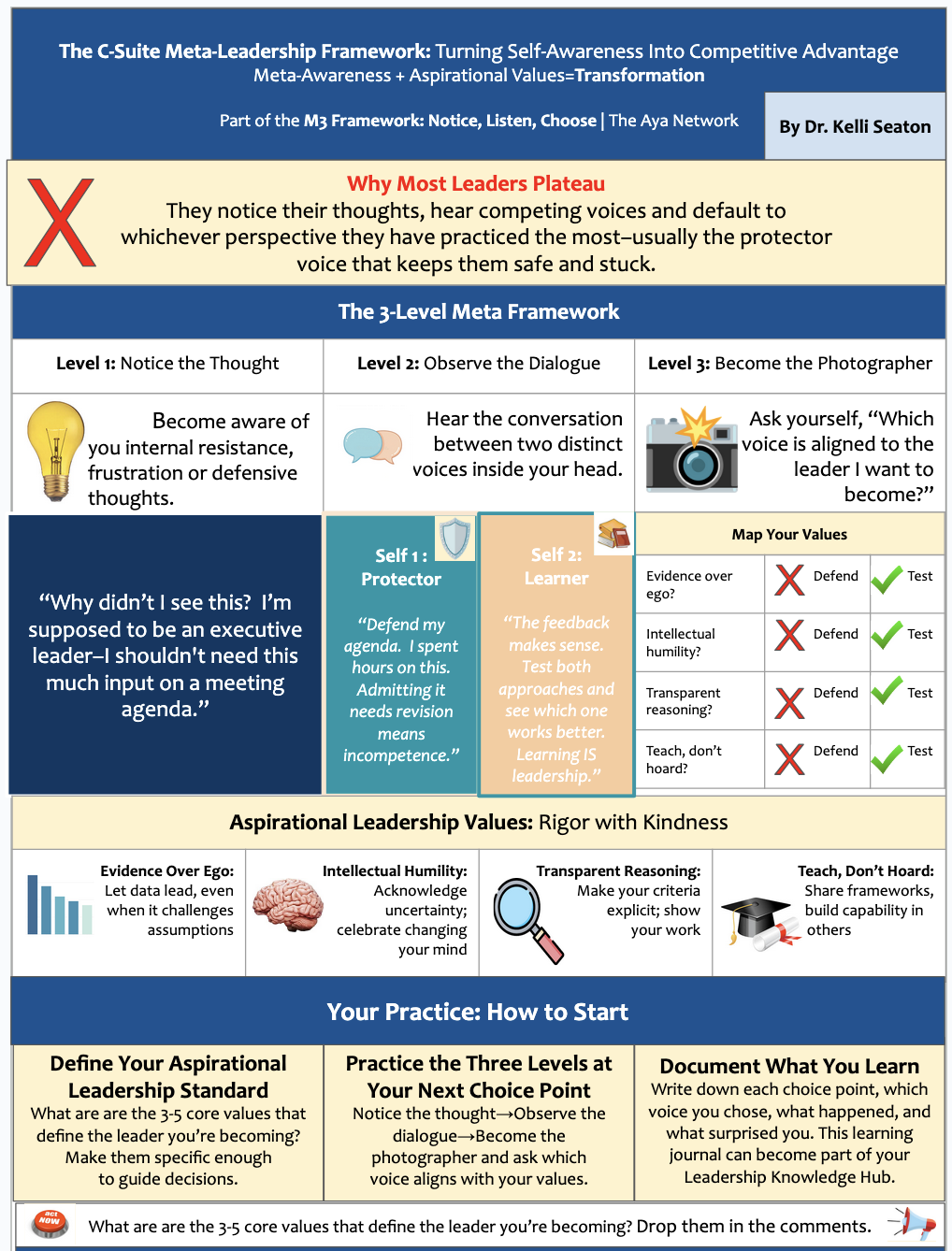
The 3-Level Meta3™ Framework
Level 1: Notice the Thought
Become aware of your internal resistance, frustration, or defensive thoughts.
Example: "Why didn't I see this? I'm supposed to be an executive leader—I shouldn't need this much input on a meeting agenda."
Level 2: Observe the Dialogue
Hear the conversation between two distinct voices inside your head.
Self 1 (Protector): "Defend my agenda. I spent hours on this. Admitting it needs revision means incompetence."
Self 2 (Learner): "The feedback makes sense. Test both approaches and see which one works better. Learning IS leadership."
Level 3: Become the Photographer
Ask yourself: "Which voice is aligned with the leader I want to become?"
This is where most leaders get stuck. They don't have clear criteria for choosing.
So they choose based on:
What feels safest
What worked before
Whichever voice practiced the most (usually Protector)
The breakthrough? Mapping both voices against your aspirational leadership values.
Aspirational Leadership Values: Rigor with Kindness
These aren't generic corporate values. They're specific, actionable decision-making criteria.
Here are the four core values I use:
Evidence Over Ego
Let data lead, even when it challenges assumptions. Use weighted decision matrices for significant decisions. Show patterns and set goals using data.
In practice: When Self 1 says "Defend your position" and Self 2 says "Test the feedback," ask: Which choice prioritizes evidence over being right?
Intellectual Humility
Acknowledge uncertainty and celebrate changing your mind. Model that learning matters more than being right.
In practice: Can you publicly say "I was wrong, and here's what I learned"? If Self 1 protects your image and Self 2 embraces learning, which aligns with intellectual humility?
3. Transparent Reasoning
Make your criteria explicit. Show your work. Build trust through process transparency, not just outcomes.
In practice: When making decisions, document your reasoning. If Self 1 says "Just decide and move on" and Self 2 says "Show the team how you arrived at this conclusion," which builds trust?
4. Teach, Don't Hoard
Share frameworks and build capability in others. Create systems for accountability rather than hoarding knowledge.
In practice: When you solve a problem, do you keep the solution to yourself or build a system others can use? Self 1 hoards to stay indispensable. Self 2 teaches to build organizational capacity.
How to Map Your Values: A Real Example
Let's return to the meeting agenda scenario from Level 1 and 2:
The Situation: You received feedback that your carefully designed meeting agenda needs significant revision.
Level 1 (Notice): "Why didn't I see this? I shouldn't need this much input."
Level 2 (Listen):
Self 1 (Protector): "Defend my agenda. Revision = incompetence."
Self 2 (Learner): "Test both approaches. Learning IS leadership."
Level 3 (Choose): Map each voice against your values:
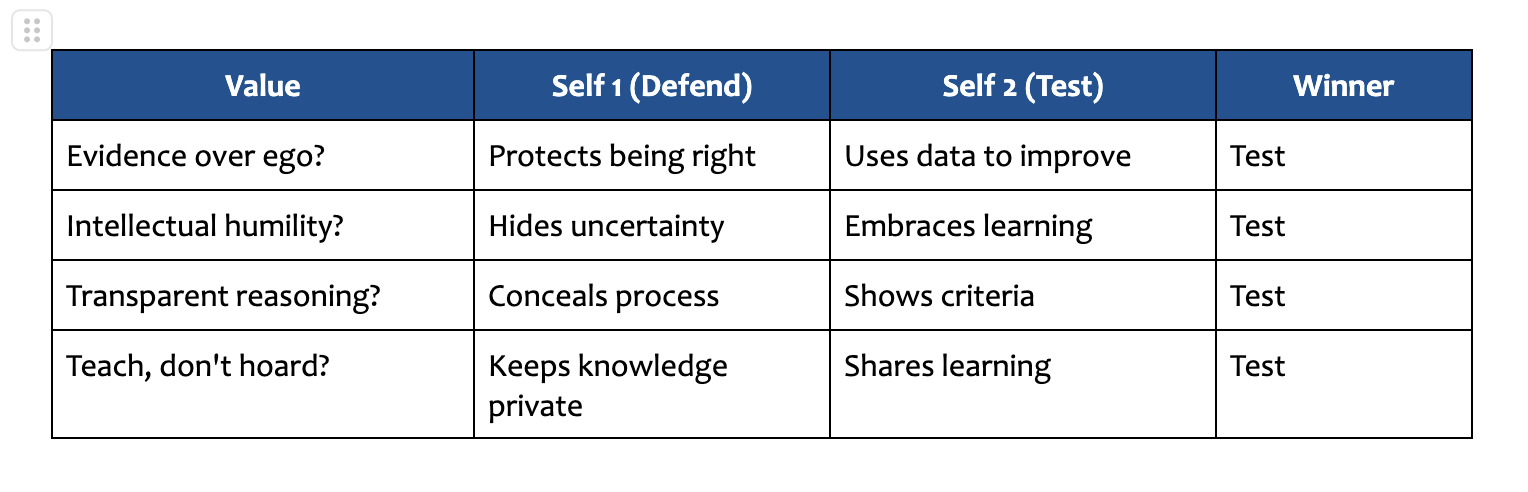
Self 1 defends. Self 2 tests. The winner? The voice aligned with your aspirational values. Next time you face a choice point, pause and ask: Which voice am I choosing right now?
Step 1: Define Your Aspirational Leadership Standard
What are the 3-5 core values that define the leader you're becoming? Make them specific enough to guide decisions.
Not this: "I value integrity"
This: "I make my decision-making criteria explicit and show my work (Transparent Reasoning)"
Step 2: Practice the Three Levels at Your Next Choice Point
Notice the thought → Observe the dialogue → Become the photographer and ask which voice aligns with your values.
Set a trigger: The next time you feel defensive, resistant, or frustrated, pause. Write down:
The thought (Level 1)
The two voices (Level 2)
Which voice aligns with your values (Level 3)
Step 3: Document What You Learn–Keep a learning journal. After each choice point, write:
Which voice did you choose?
What happened?
What surprised you?
The result?
You choose Self 2 (Learner).
You test the feedback.
You build problem-solving infrastructure.
This is transcendental evolution: You caught the ego block, heard both voices, and chose based on aspirational values—not ego protection.
Why This Matters: Destructive vs. Transcendental Evolution
Remember: You're always evolving. The question is which direction.
If You Consistently Choose Self 1 (Destructive Evolution):
You defend your position → Team sees rigidity
You avoid the feedback → Problems persist
You protect your image → Trust erodes
You hoard knowledge → Team can't scale
Predictable outcomes:
Team trust: 2-3/5
Attrition: 25-45% annually
Clarity failures: 20-40%
Cost: ~$2.5M per 10 employees
If You Consistently Choose Self 2 (Transcendental Evolution):
You test the feedback → Team sees growth
You embrace learning → Problems get solved
You show vulnerability → Trust builds
You teach systems → Team scales excellence
Predictable outcomes:
Team trust: 4-5/5
Attrition: 8-15% annually
Clarity failures: <10%
Savings: ~$1.7M per 10 employees annually

Meta3™ + The Human Connection
Evidence over ego means listening to the people in front of you, not just the voice in your head.
The choices compound. Every time you choose Protector, you evolve destructively. Every time you choose Learner, you evolve transcendentally.
Your Practice: How to Start
Step 1: Define Your Aspirational Leadership Standard
What are the 3-5 core values that define the leader you're becoming? Make them specific enough to guide decisions.
Not this: "I value integrity"
This: "I make my decision-making criteria explicit and show my work (Transparent Reasoning)"Step 2: Practice the Three Levels at Your Next Choice Point
Notice the thought → Observe the dialogue → Become the photographer and ask which voice aligns with your values.
Set a trigger: The next time you feel defensive, resistant, or frustrated, pause. Write down:
The thought (Level 1)
The two voices (Level 2)
Which voice aligns with your values (Level 3)
Step 3: Document What You Learn–Keep a learning journal. After each choice point, write:
Which voice did you choose?
What happened?
What surprised you?
This documentation becomes part of your Leadership Knowledge Hub—a system for compounding organizational capability.
The Critical Warning
Here's what most people miss: Meta3™ is amoral.
If your aspirational values are destructive (manipulation, theft, dishonesty), Meta3™ will make you more effective at harming others. You'll strategically choose the voice that serves your ego, not your growth.
That's why the values matter. They ensure Meta3™ serves transcendental evolution—building capacity, scaling excellence, retaining talent—not destructive evolution.
The formula:
Meta3™ without values = Analysis paralysis (you never choose)
Meta3™ with destructive values = Strategic harm (you choose ego)
Meta3™ with aspirational values = Transcendental evolution (you choose growth)
What's Next: Next week, I'll break down the 5 specific ego blocks that derail C-suite leaders:
Defend Image (shows up when receiving feedback)
Avoid Conflict (shows up when behavior is problematic)
Control (shows up when considering delegation)
Ruminate on Offense (shows up after criticism)
Scapegoat (shows up when projects fail)
I'll show you a real example of how Meta3™ transformed a team's problem-solving process—and give you the systems to identify your own patterns.
Your turn: What are the 3-5 core values that define the leader you're becoming? Complete the Aspirational vs. Practiced Values Assessment, build your Transcend Circle, and get ready to apply what you learn even more about yourself and your impact!
Follow Dr. Kelli Seaton for the Meta3™ Framework series.
#Leadership #Meta3™Framework #AspirationalValues #ExecutiveLeadership #TranscendentalEvolution
